
When planning a bathroom renovation, most homeowners focus on finishes — tiles, tapware, vanities and lighting. However, one of the most critical elements of long-term performance is invisible: ventilation. By the end of this article we will identify how ventilation impacts bathroom renovations.
Humidity is the silent risk inside every bathroom. Without effective airflow, moisture penetrates plasterboard, timber framing, cabinetry and insulation. Over time, this can lead to peeling paint, warped joinery, mould growth and even structural deterioration.
Professional renovation companies treat moisture control as a core building requirement, not an optional upgrade. Experienced specialists such as RJG Group Bathroom Renovations integrate ventilation strategy into the design phase to protect both aesthetics and structure.
According to building maintenance professionals, trapped humidity is the leading cause of bathroom surface failure within the first 6–12 months after renovation. The damage often develops behind walls long before visible signs appear.

Robert Ghalbouni, CEO of RJG Group, explains:
“A renovation should last decades, not years. Renovation planning is one of the most important steps in protecting that investment.”
Choosing the Correct Fan Size: Understanding CFM
Ventilation effectiveness begins with selecting the right exhaust fan capacity. This is measured in CFM (Cubic Feet per Minute) — the amount of air a fan can move.
The general industry guideline is simple:
1 CFM per square foot of bathroom space.
For example:
- 8 ft × 10 ft bathroom = 80 sq ft
- Minimum recommended fan rating = 80 CFM
If the bathroom includes high steam features such as dual showers or a spa bath, an additional 50 CFM is typically advised.
An undersized fan cannot clear humidity effectively. Oversizing without proper ducting can also reduce efficiency. Correct sizing ensures balanced air exchange.
These airflow principles also apply beyond bathrooms. Kitchens generate cooking steam and grease vapour, while laundries create condensation from dryers and washing machines. Projects like RJG Group Kitchen Renovations and RJG Group Laundry Renovations incorporate ventilation planning to manage moisture loads in all wet areas.
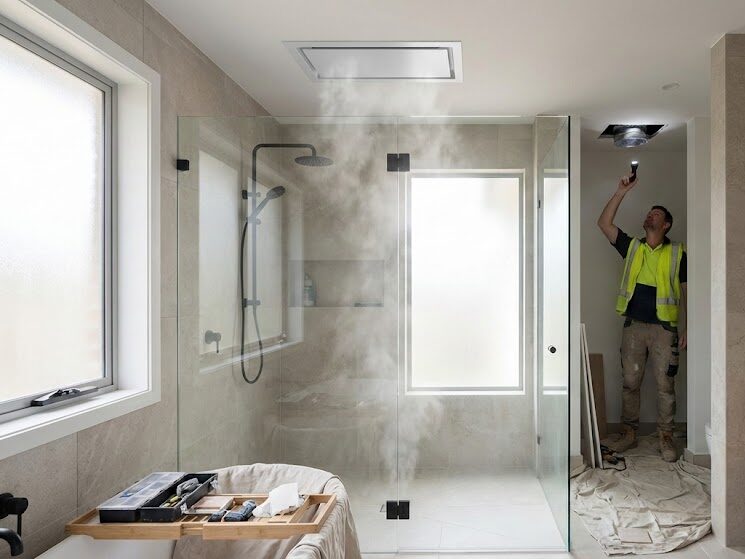
Noise Matters: Understanding Sones Ratings
Even a properly sized fan becomes ineffective if homeowners avoid using it because it is too loud.
Fan noise is measured in Sones:
- 4.0 Sones – Comparable to a busy office
- 2.0 Sones – Quiet office
- 1.0 Sone – Soft refrigerator hum
- Below 1.0 – Virtually silent
For residential renovations, selecting a fan rated 1.5 Sones or lower is recommended. Quiet systems encourage consistent usage, which directly improves moisture control.
Ventilation design is not just about airflow power. It must consider real-world behaviour.
How Ventilation Impacts Bathroom Renovations: Why Ductwork Is Critical
The exhaust fan itself is only part of the system. Ductwork determines whether humid air actually exits the home.
Common installation mistakes include:
- Long, sagging flexible ducts
- Multiple sharp bends
- Venting into attic spaces rather than outside
Each of these reduces airflow efficiency and can cause condensation buildup.
Best practice includes:
- Short, straight duct runs
- Rigid smooth-walled ducts
- Airtight connections
- Exterior vent termination
Poor duct design can reduce effective airflow by up to 50 percent. Professional renovation teams treat ventilation as a complete system rather than a single fixture installation.
How Ventilation Impacts Bathroom Renovations: Smart Features That Improve Protection
Modern exhaust systems offer features that remove user error:
Humidity Sensors
Automatically activate when moisture levels rise and turn off once air dries.
Timers
Allow the fan to run 15–20 minutes after shower use.
Continuous Low-Speed Ventilation
Maintains steady airflow throughout the day.
These features provide consistent protection, particularly in family homes where manual use may be inconsistent.
How Ventilation Impacts Bathroom Renovations: Ventilation as Structural Insurance
Moisture affects more than paint. Long-term humidity exposure can result in:
- Timber swelling and joint separation
- Cabinet warping
- Silicone breakdown
- Hidden mould growth
- Increased strain on HVAC systems
This is why ventilation should be considered part of the waterproofing strategy, not a secondary feature.
Robert Ghalbouni emphasises that airflow planning is fundamental to renovation longevity:
“Controlling moisture is just as important as selecting quality materials. Without proper ventilation, even premium finishes can fail prematurely.”
Pre-Renovation Ventilation Checklist
Before construction begins, homeowners should ask:
- What CFM rating suits the room size?
- Can we install a fan rated 1.5 Sones or quieter?
- Where will the duct exit the building envelope?
- How will the duct run remain short and airtight?
These questions ensure ventilation is integrated into the renovation plan before walls are closed.
Final Perspective
Ventilation represents a small portion of a renovation budget, yet it protects the entire investment. Whether upgrading a bathroom, redesigning a kitchen, or modernising a laundry, airflow strategy ensures finishes remain durable and structural elements stay dry.
A well-executed renovation should not only look exceptional on completion day — it should continue performing for years. Proper ventilation is what makes that longevity possible.